
Vocal Diagnostics as Devotional Listening
Love is the only true conduit of knowledge ⭃⬷

Do you feel it?
It's really there now.
The mutuality.
It has been a year since I began publishing, and only now am I starting to feel our channel open.
It’s an inner sense of direct contact. I feel it through my voice — how? maybe this article will help me understand.
First thing, you are here and I am happy. I couldn’t be writing without you.
If I didn’t deeply desire to be heard, read, seen— I wouldn’t have the movement in me, the impetus to speak, the desire.
'faye' is just an example of a 'me' . Any ME has this desire as part of its nature; we want to arrive, show up, find specificity in the field, encounter, meet and touch.
So if there is a voice, there is also a listener implied, like two poles of the same orbit.
A greater movement than the local identity is constantly speaking through me — through any one of us.
Love itself moving, changing forms, singing — as wisdom, as light.
‘Creativity’ would be the unique way this specific ‘me’ is momentarily containing and translating that love so as to serve her shining.
The genius of the voice is that energy and meaning, intention and manifestation are on the same channel of perception, so following the voice’s path can help us entrain back to a reality where there is no separation thinkable between speaker and listener.
Practicing this type of devotional listening can show us ‘how to be with each other when we are actually members of the One unified field’.
a Rainbow-bridge question.
The realization of inherent continuity of source and receiver lies at the basis of the diagnostic capacity of our voice.
Discovering your Voice as a way to touch and make sense of reality complements the “I know” and extends it into “knowing arises between experience and myself”.
⭃⬷
I have already written about how voice expands embodiment beyond the physical body, re-links damaged neural perceptual pathways, helping us to locate ourselves more precisely in the vibrational field.
What we will talk about in this essay is the practice of vocal diagnosis, which covers the way we choose to be positioned towards that information, and how we, still through our voices, translate this embodiment process into meaning.
Curious to feel what this work can do for you?
On Wednesday the 27th at 19:00 CET, I’ll be a teaching a basic practice.
Access the practice by becoming a paid subscriber or a member of the Plexus Choir.
The Gnosis of Dia
Certainty can bring alleviation, but not healing
The genius of the voice is that the knower is not separate from the object of its inquiry. Energy and meaning are on the same channel of perception.
How does this work?
First, let us listen to the Greek word DIAGNOSIS
DIA - διά (dia-): a prefix meaning ‘through’, ‘apart’, or ‘thoroughly’.
Gnosis — γνῶσις, from γιγνώσκειν (gignōskein) — 'to know' or 'to perceive’.
In our culture today the word is often associated with the medical and reduced to a noun.
You ‘get’ a Diagnosis.
‘What is your diagnosis?’ means something like: ‘How were your symptoms, issues, experiences and questions given a label? Were they finally collapsed into some ‘thing’ that you ‘have’?’
Finally ‘diagnosed’, you can now be placed in the pathway of cure — within the high-fenced gardens of systemic medicine.
Yet if we lean into the word’s etymology, we can see that diagnosis is about knowledge that has gone through something.
We need to go through something in order to know.
And if we want to know ourselves, that is what we need to go through.
If “Know thyself” is the Mysteries’ timeless imperative, then as supporters of today’s collective initiation our job has more to do with conducting than with acting, more with fully receiving and re-arranging what is than trying to add to or eliminate from the system.
Do we need to arrive at a fixed definition of our state in order to heal ourselves? Furthermore, is it our job to authorize or negate someone else’s experience through a label? Can we determine what someone is without being affected by it?
I’m saying that we have incredible capacity to both understand as well as harmonize and heal ourselves through the power of our own voice and do this in a way that would make most of today’s therapies and strategies obsolete.
It sounds pretentious but it’s really not such a far out thing — it happens anytime you yawn, or hit your toe on the edge of the bed and yell. Any beloved receives you through your voice. We feel each other and transmit beyond our ideas and constructs.
This happens all the time.
If we don’t need the DSM or an academic degree in order to support our own and another’s process of self knowledge, what DO we need?
The structural ground may quake for a moment, but luckily, natural structure has been there all along— it can now resound through the practice of devotional listening.
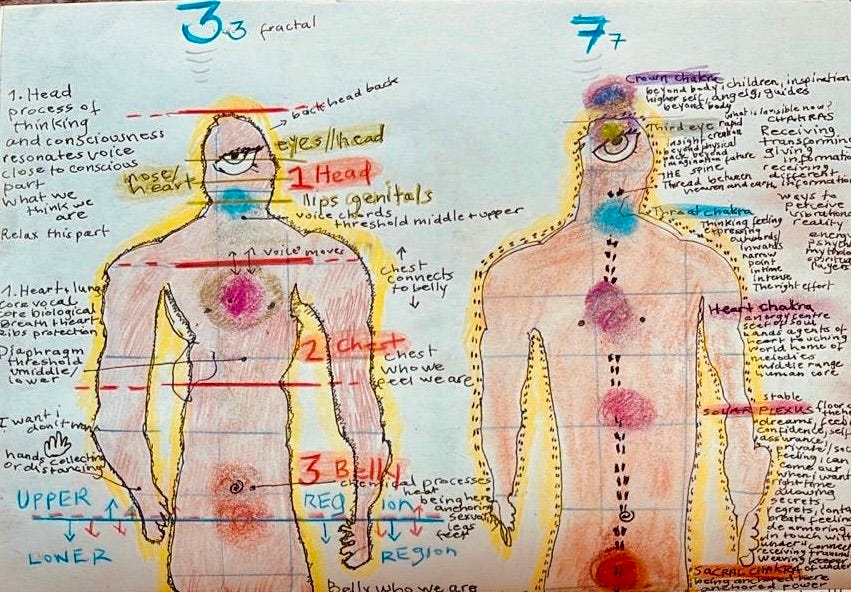
The Chain of Vocal Diagnosis
If you want to know what a cup is made of, you tap on it— the sound can directly reveal if it's glass, plastic, or paper.
The same exact principle is at the basis of vocal diagnosis, you sort of ‘tap’ on yourself from the inside with the subtle vibrations of your voice — and so you know what you’re made of.
Because we are not inanimate objects but living beings, there are a good few more dimensions to consider, but luckily the voice contains them all.
The links in the chain of vocal diagnosis are not steps to implement — as some of them may not be reached immediately.
The chain formalizes the natural dynamics of allowing the voice to guide back to its source so Devotional Listening can be practiced.
1. Entangling
Within a container that allows the mind to relax, we let what is latent unfurl. This invitation requires trust, because the cause for the repression is often a lack thereof.
This is why our main conduit for this work is connection. It is the practice of devotional listening — (not as an aesthetics or a religion but devotion as clean presence — a moment to moment decision to stay-with and expand-into.
Our position is not neutral, it is welcoming, a kind of vibrational hospitality.
This anchoring in love is a gift that strengthens with practice. If you don’t naturally love voice it wouldn’t work. My students and I cultivate a belief that the voice is the resonant expression of the moment and is imbued with everything — all the guidance and resources needed to promote your movement towards congruence.
Having a voice be received like that — even if that was the only thing to occur in a session — could mean the world.
The energy of this exchange is essentially similar to that of a mother to the infant: what is this cry? is he hungry? is he uncomfortable? you don’t understand it yet - but you are 200% there, open to receive, to sooth and interpret - it is knowledge mounted on the channel of attachment1 with a transpersonal-personal awareness.
2. Discerning
What's mine and what's yours?
Opening our minds into vibrational reality, the way we interweave with each other brings both distinct challenges as well as exciting possibilities.
Here, the facilitator’s inner work is key.
Since most of the cues are somatic/vibrational, the conscious mind is in a process of moderating understanding — so one has to be deeply acquainted with one’s system in order to differentiate between:
what is mine.
what in me is being activated.
what belongs to the client yet arrives through my channel.
This is never a clean cut separation and the information is always for both.
The facilitator, anchored in their body needs to navigate the fullness of information and cultivate discernment through knowing their own voice and inner structure, so as to consistently pursue truth.
Having a Structural sense of self means that I know and am in nurturing, rigorous relationship with my personality, inner life, and its operational patterns. The Self then becomes a sort of zero-point reference that allows me to recognize “other” information as what it is.
Beyond that is knowing the right questions to ask, how to approach and reach the depths in a way that opens and relaxes. This all happens through your tone of Voice.
3. Weaving
Allowing the voices to blend and generate new frequencies.
Many waves of open sighs, silence in between, the voice touches the core, going through the layers. Naturally, the voices attract, merge.
As a practitioner, your practice here would be feeling into the membrane of connection — the place where our voices meet — as the source of the music of now.
As our vocal channels become clearer and freer to include more and more of ourselves we can feel that their meeting has its own dynamic, its own movement. It is a zone of shared energy, of the Third — the element that results between the two of us.
This vocal TAZ (temporary autonomous zone)2 has a magical enlivening air to it — this is what music is for. Operating in this realm is beyond healing and roles of facilitator and client — meeting there can take endless forms, all alive.
4. Arriving
Arriving and going through observations while designing and conducting an experiment.
After immersing ourselves in waves of voicing, merging and receiving a sea of data, we may start to land at observations. They might be things like: the pelvis is tight, the chest is exposed, there is much shame. at this point our job is not to prove this right or wrong.
Instead of having an analytical conversation about it we can try something out: pelvis tight? move your knees side to side — too exposed?— turn around to your side. Let’s see how that sounds.
Getting a bit of knowing and translating it into how I position myself in relation to the voice.
By staying close to how the voice sounds we stay open to the feedback received from our experiments.
There’s a beautiful German word for that — Tasten — which means both checking and touching.
In the training I teach practitioners specific sets of questions to ask, but every practitioner will inevitably develop their own style and approach observation and design experiments in their own way.
Arriving at Simplicity
These are a lot of words for something that honestly feels very basic and primal — much of this arises naturally once the pressures of our culture soften enough for us to truly listen.
This practice is beyond a modality, it is a re-wilding process, not only of our voices but of our ways of listening.
To rewire our vibrational awareness is to notice what Sophie Strand calls neural pruning — the way our culture cuts us off from the beings and resources that could mean the world to us — keeping us in a lonely, artificial perceptual prison.
This regeneration has no end and like any birth is organically woven with grief.
Knowing is an act of Generative Participation
If reality is nothing but myself in different time-lapsed reflections, and the seeming "me" is nothing but listening itself, receiving this ever-changing flow — then diagnosis, "knowing through", is how we travel the path between them.
Vocal diagnosis is basically about love;
It is the way we can keep the connection to the source of the signal while allowing it to fully differentiate — to be completely the way that it is right now — without losing touch with the generative dark core — the source of listening itself.
Voice work goes far beyond healing - it is anchored in relating — the possibility to both surrender and lead, to create and enjoy the endless changes of creation.
This is the way I know, that if you're here, I know my voice has reached you,
And if it didn’t, it’s okay.
I know I only speak to what hears me.
I wrote about the connection between our vocal expression and the attachment/vocal ego emergence in Tonal Orientation.
Merging voices can be the intimate embodied fractal for TAZ to occur. see APA Bey, H. (1991). TAZ: The temporary autonomous zone, ontological anarchy, poetic terrorism. Autonomedia.