
I WANT CO-SELF-ARISING RAVES
on mechanized grids, water-bodies, and finding your own place on the dance floor

At that time I was living in Basel — a Swiss city halved by the river Rhein.
I had recently broken up with my boyfriend and had moved to a “WG” — an apartment with 4 other students. That night I was 23, and went with my new roommates to a party.
As we rode our bicycles to the industrial cargo port, we could hear Drum’n’Bass booming from the direction of the water. Our party was on a boat; its windowless belly was the dance floor.
The year was 2006 and I loved that music. It was all about irregular quirky drum sounds, fast and odd. We drank, which I was not accustomed to and surely enough I got very drunk, and couldn’t stand.
My roommate took me to a little platform on the side of the dance floor, that kind where people put their bags on. She was chatting and smoking as I laid myself on random coats. Everything was spinning.
There was nothing else I could do but listen.
It was then when I finally heard it:
That seemingly quirky, defiant music was actually constructed on a 4x4, computerized rhythmic grid. The bpm kept boringly stable, all that oddness I liked was decorative, added on top of the mechanic repetition, camouflaging the duplicated time frame.
I saw how all of us young dancers, getting drunk, sharing a much needed space of release and connection, unconsciously allow ourselves to be entrained by a giant, spider-like sonic entity. Our small water-bodies hop on the big water-body of the river, our feet stomping the boat’s floor with an eerily precise, repetitive beat. A rhythm that is not our own.
This was life-changing.
From that point on, I became acutely aware of how almost all of the music we hear — not only dance music but ANY music — on the radio, in shops in cafes, in parties — basically anywhere public — is set on top of a quantified, computer-mechanized time-frame.
You don’t need to be a musician for this to affect you — your body is constantly being touched by this music.
Your own rhythms, the heartbeat, the frequencies of the nervous system, brain activity — all those delicately orchestrated bio-psychic processes are meeting an environment that does not resonate with them, that constantly gives the message: this is not your place.
What is the cost of dancing to mechanized grids?
This music has become the norm. Even if we happen to encounter different, live music, our perceptive habits aim for and prefer mechanically organized music. To return to natural timing becomes an acquired taste.
Don’t get me wrong. This is not about purism.
I still enjoy electronic music when it’s good and listen to DJ sets when on a treadmill — in fact, my mind often relaxes within this environment. It is a predictable and reliable timing container, and I am used to it.
I tell myself it just might be necessary — how else could we survive the corporate, capitalist institutionalised culture we’ve inherited — if we’re not able to adapt to that grid, to dance along its confinement?
However, there is a cost, and one must ask if it’s worth it.
What is pulsing and vibrating on the bio level that needs our attention?
How could the subtle levels, our voice, the rhythm of our thoughts and our breath inform our movement, our presence?
Do dance, song, movement have a deeper and more practical function other than just entertainment?
How can we learn to love our perfectly imperfect organic Wabi-Sabi rhythms and wean ourselves from the mechanized grids? How can we fall in love with the complexity and order of natural time?
How will it affect us to entrain back into our inner rhythms and away from the collective machine grid? What would be the ripples of that transition?
But by now you and I both know that living outside of some order is impossible.
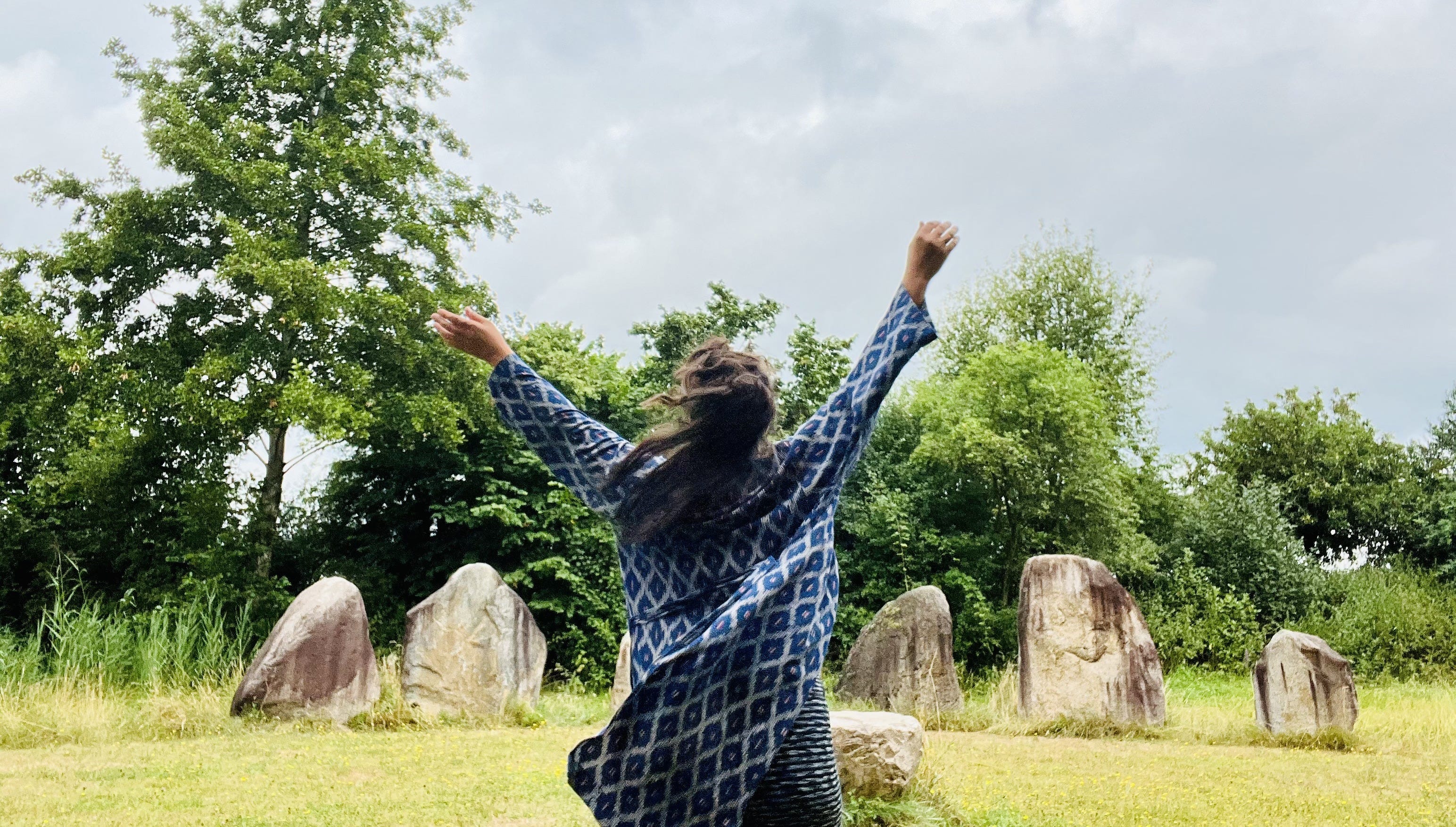
Culture needs synchronizing processes
Hypothetically speaking, if there was just one person, alone, their body’s somatic timing, informed by the field, would be enough.
However, we are not alone.
We are many — that need and want to meet; that thrive on togetherness — which requires synchronization.
This is not just a social or a political question. It is a metaphysical one.
If matter is just energy slowed down and energy is matter sped up — whatever reality we are experiencing depends on the tuning of our antennas. To share a space of perception is to share a speed.
We are literally co-stabilizing our reality by the rhythms of our perception.
Our voices help us attune to each other and meet on a common ground.
As I explained in this essay, the voice is not one continuous thing. It is made by moment-to-moment pulsations that generate rhythmic frequencies — that may then be experienced as a solid tone.
So the voice, in its percussive aspect, can become a synchronising reference. A liminal but effective point of awareness which both creates as well as receives varied time dimensions — that are always, by definition, inspiring health.
To quote Tenzin Wangyal Rinpoche “..when we are producing sound, we are relating to the breath and vibration of the sound itself in a sense. It is very pure. The producer is the listener. The listener is the producer — in this way we can experience the sound of self arising.”1
This self-arising quality is what paves her own way through layers of ignorance and numbness. And since we are doing this together it is CO-SELF-ARISING.
How does that music sound?
What I believe we are needing are experiences of communion and connection in a true and embodied way.
Until we learn to dance sing and exist in consideration of our own, uniquely emanating living system's signals we will never be truly entrained to its available nourishment — finding our own unique place on the dance floor.
The most powerful instrument you have for this is already inside you.
If you feel called to explore it, I have two entry points opening soon:
Synchronising with natural time — a new online group session beginning Friday 15.5, offered every 13 days in synch with the Dreamspell — starting with the Earth wave. (60 min practice)
Voice meditation sessions — a deep dive into vocal somatic awareness, weaving Vipassana-inspired attunement with vocal practice. (90 min. practice)
Both are part of the Plexus Choir Membership — an accessible way to enter into this field and begin.
Tibetan sound healing : seven guided practices to clear obstacles, cultivate positive qualities, and uncover your inherent wisdom, by Tenzin Wangyal Rinpoche.